
Abstract
1. Introduction
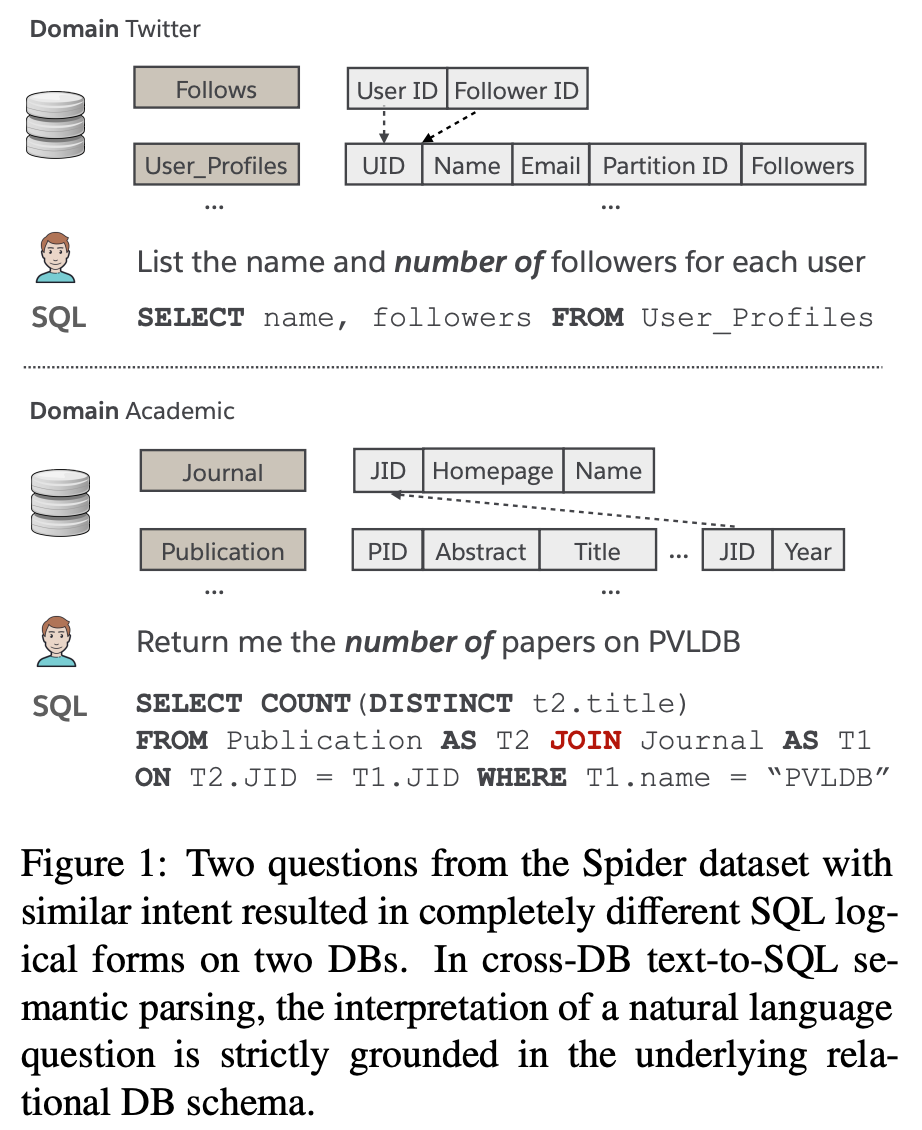
- Text-to-SQL semantic parsing 문제는 자연어 발화(NL utterances)를 실행가능한 관계형 데이터베이스 쿼리(relational DB queries)로 매핑하는 문제다.
- 모델은 훈련때 보지 못한 관계형 데이터베이스에서 질문의 의도를 파악하고 정확한 쿼리를 만들어야 한다.
- 지금까지 다른 연구들은 3가지 디자인 원칙으로 진행되고 있다.
- 질문과 스키마 표현들이 서로 연관(문맥화 contextualized)되어 있다.
- BERT나 RoBERTa와 같은 Pre-trained Language Models이 변화무쌍한 자연어에 대해 일반화를 잘 할 수 있고, 장기적인 의존성을 포착하여 구문 분석 정확도를 크게 높일 수 있다.
- 데이터베이스를 더 많이 학습 할수록 모델의 스키마에 대한 이해도는 높아진다.
- 스키마와 질의에서 나오는 단어를 잘 연결하기 위해서, BRIDGE는 anchor text를 포함한 하이브리드 시퀀스를 만든다. Anchor text는 DB와 자연어 질의에 공동으로 등장한 단어들이다.
2. Model
2.1 Problem Definition
- 자연어 질의를 , 관계형 데이터베이스의 스키마를 , 해당하는 SQL을 로 정의함
- 스키마는 테이블 , 필드 로 정의된다. 이 중에 몇개는 primary key, foreign key가 할 수 있고, 각 필드는 고유한 데이터 타입이 있다.
- DB Contents를 고려한 모델(현실적이지는 않을듯..)
2.2 Question-Sechema Serialization and Encoding
- 테이블과 필드는 각각 스페셜한 토큰 와 를 가지고 있음, 자연어 질의와 스키마는 토큰으로 분리되어 있음
- 는 BERT로 인코딩하고 bi-directional LSTM를 통과해서 base 인코딩된 을 얻는다. 그리고 질의 부분은 다른 bi-directional LSTM을 통해 를 얻고, 를 사용해 의 일부로 각 테이블와 필드에 해당하는 인코딩을 얻는다.
- dense look-up features(임베딩)로 스키마 메타 데이터를 학습한다. 스키마 메타 데이터란 primary key(), foreign key(), 데이터 타입()을 말한다.
- 메타 데이터 피처들은 feed-forward()를 통과해서 최종 인코딩을 구한다.
- 는 에서 테이블 에 해당하는 의 인덱스, 는 에서 에 해당하는 의 인덱스, 는 각각 에 해당하는 특성 인덱스다.
2.3 Bridging
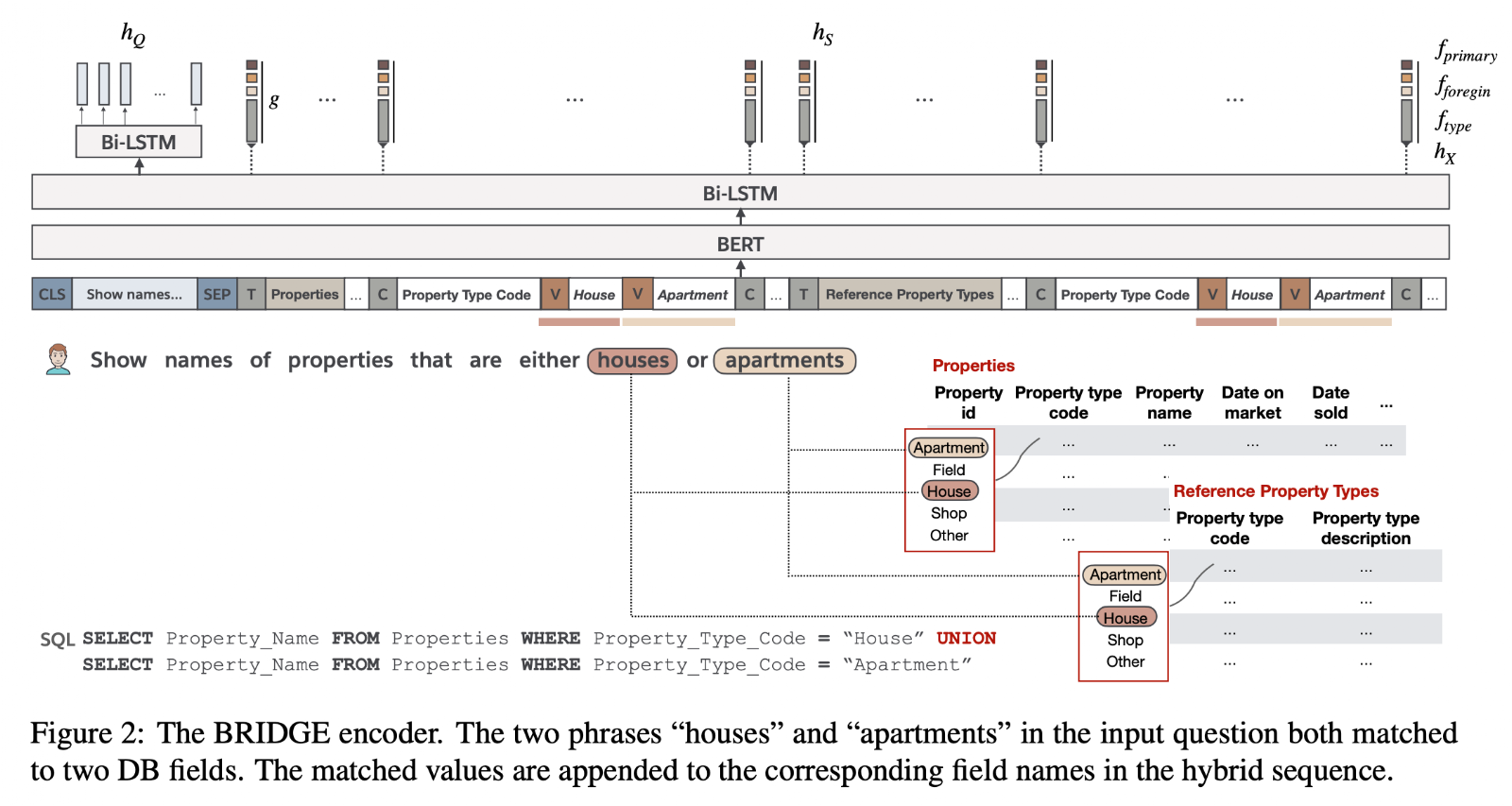
- 필드의 실제값에 접근하지 않으면 해당 필드가 질의에 해당하는 단어와 연관이 있는 지를 알 수가 없다. 따라서 anchor text를 이용해 이 연관성을 연결하려고 한다.
- 와 데이터베이스의 필드 값(picklist)의 string match를 통해 매칭된 값이 에 들어가게 되며, 토큰으로 분리된다. 만약에 값이 두 개 이상이 되면 값을 concatenate 한다. 여러 테이블에서 같은 필드가 들어가도 그대로 두었음(resolve ambiguity목적: 어떤 모호성?)
- 이러한 과정을 ‘bridging’이라고 함
2.4 Decoder
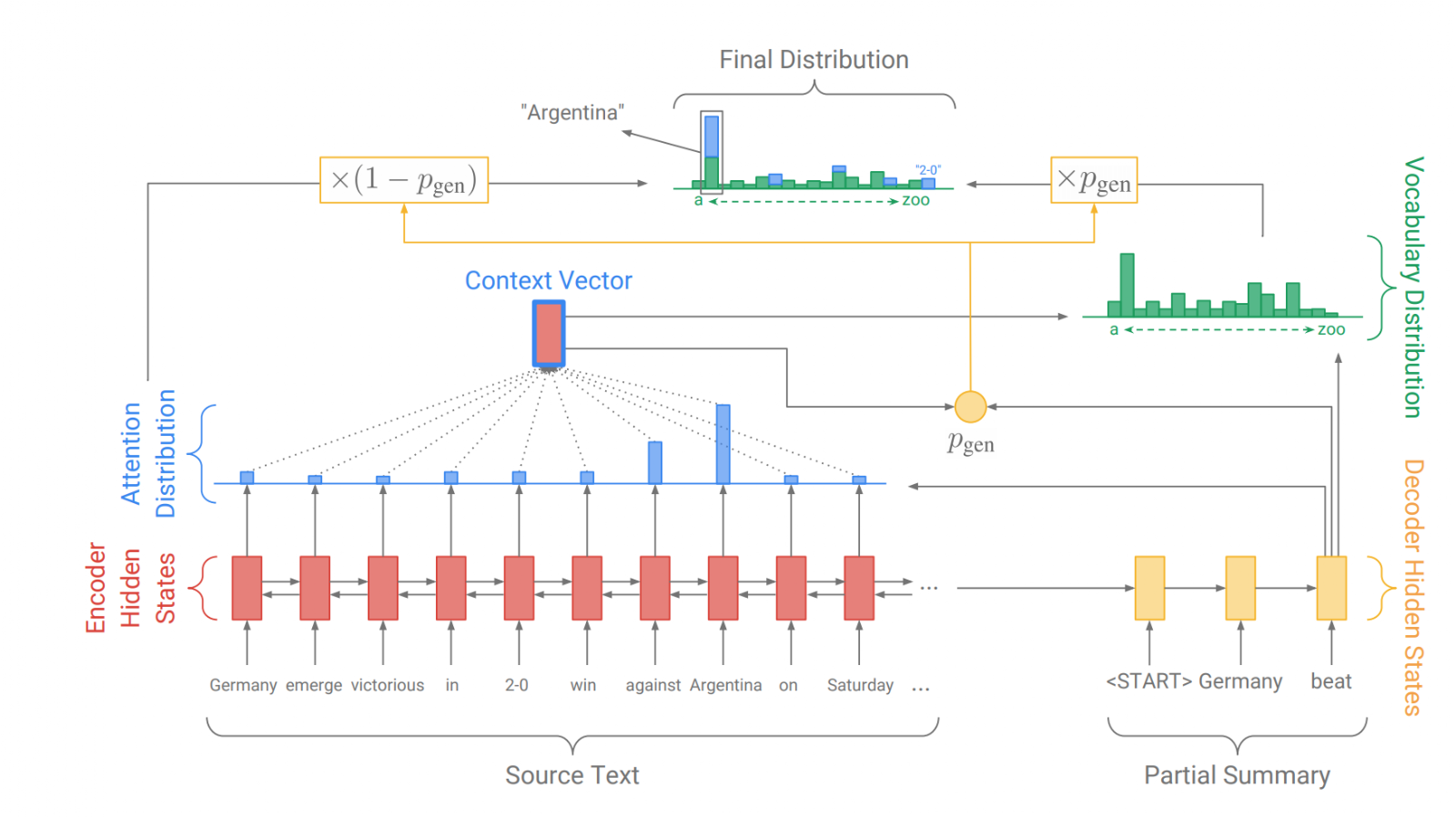
- LSTM 기반 point-generator[^3]와 multi-head attention을 사용, init-hidden은 마지막 질의 인코더의 hidden state 사용
- 매 스텝 마다 단어장()에서 토큰 생성하거나, 질의 의 토큰 혹은 스키마 의 요소를 복사한다(Copy Mechanism). 스텝(), decoder 상태(), encoder representation를 , 를 head 개수로 정의한다면, 수학적으로 다음과 같다.
[^3]: [Get To The Point: Summarization with Pointer-Generator Networks](https://arxiv.org/abs/1704.04368)- 단어장에서 토큰을 생성할 확률은 다음과 같다.
- $P_V(y_t)$는 decoder LSTM의 출력 확률, $\tilde{X}$은 $X$에서 질의 단어 토큰, $[T], [C]$만 담은 시퀀스이며, 총 길이에서 $\vert Q \vert + \vert S \vert$를 뺀 값이다.
- $p_{gen}^t$은 토큰이 스텝 $t$에서 복사될 확률, $e_{t-1} \in \Bbb{R}^n$는 스텝 $t-1$일 때 단어장 생성된 토큰 임베딩이거나 테이블, 필드 혹은 질의 토큰중 복사된 벡터이다.
- $\zeta_{t-1}\in \Bbb{R}^n$는 스텝 $t-1$일 때 encoder 히든 상태의 가중합인 selective read 벡터다. 여기서 $K=\sum_{j:\tilde{X}=y_{t-1}} \alpha_{t-1, j}^{(H)}$로 normalization term이며, $\tilde{X}$의 다른 포지션에서 $y_{t-1}$가 동일하게 나올 수 있기 때문이다.2.5 Schema-Consistency Guided Decoding
Generating SQL Clause in Execution Order
- Written order 대신 execution order 순으로 decoding
"Written": SELECT FROM WHERE GROUPBY HAVING ORDERBY LIMIT
"Exec": FROM WHERE GROUPBY HAVING SELECT ORDERBY LIMIT- Lemma 1: 가 execution order SQL이라면 모든 의 테이블 필드는 항상 테이블 뒤에 나타난다.
- Lemma 1로 인해서 binary attention mask 를 적용할 수 있다. 처음에는 0으로 초기화하나, 테이블 가 디코딩 되었을 때, 토큰에 해당하는 를 1로 준다. 이로인해 decoder가 search space 조금이라도 줄였다.
- Lemma 2 Token Transition: 가 실행가능한 SQL이라면, 모든 의 테이블 혹은 필드는 SQL 예약어 토큰 뒤에 등장할 수 밖에 없다. 에서 모든 value 토큰은 항상 SQL 예약어 토큰 혹은 value 토큰뒤에 나타난다.
- 이러한 휴리스틱한 방법을 사용해 후보군을 줄여갔다.
3. Related Work
- 논문 참고
4. Experiment Setup
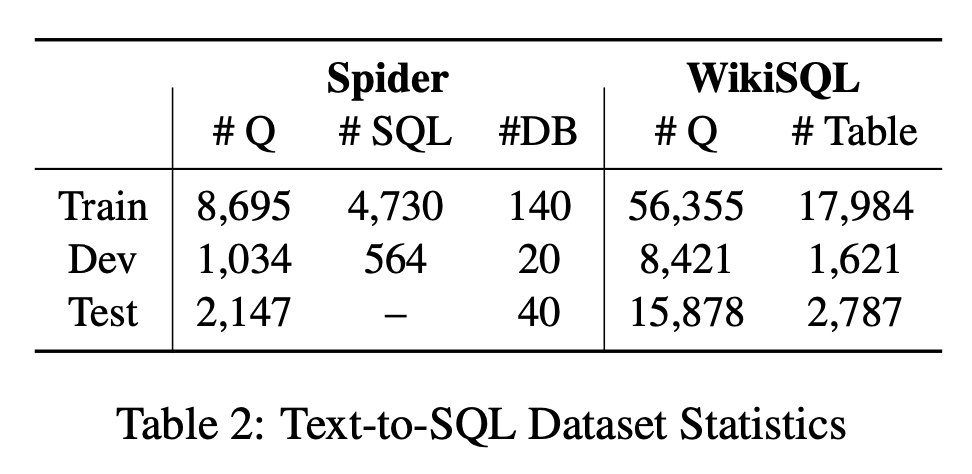
4.1 Dataset
4.2 Evaluation Metrics
- Exact Match(EM): 예측한 SQL 문구와 ground truth와 정확하게 일치하는 지 본다. 이는 의미적으로 일치하는 SQL이 표면적으로 ground truth와 다르다는 점에서 성능 하한으로 볼 수 있다.
- Exact Set Match (E-SM): 예측된 SQL를 구조적으로 일치하는지 확인, 방법은 예측한 SQL 구문의 집합을 순서와 관계없이 ground truth와 비교한다.
- Execution Accuracy (EA): 예측한 SQL이 target 데이터 베이스에서 실행 결과를 ground truth SQL을 실행 시켰을 때의 결과와 얼마나 일치하는지 보는 것이다. 이는 성능 상한으로 볼 수 있다.
4.3 Implementation Details
Anchor Text Selection
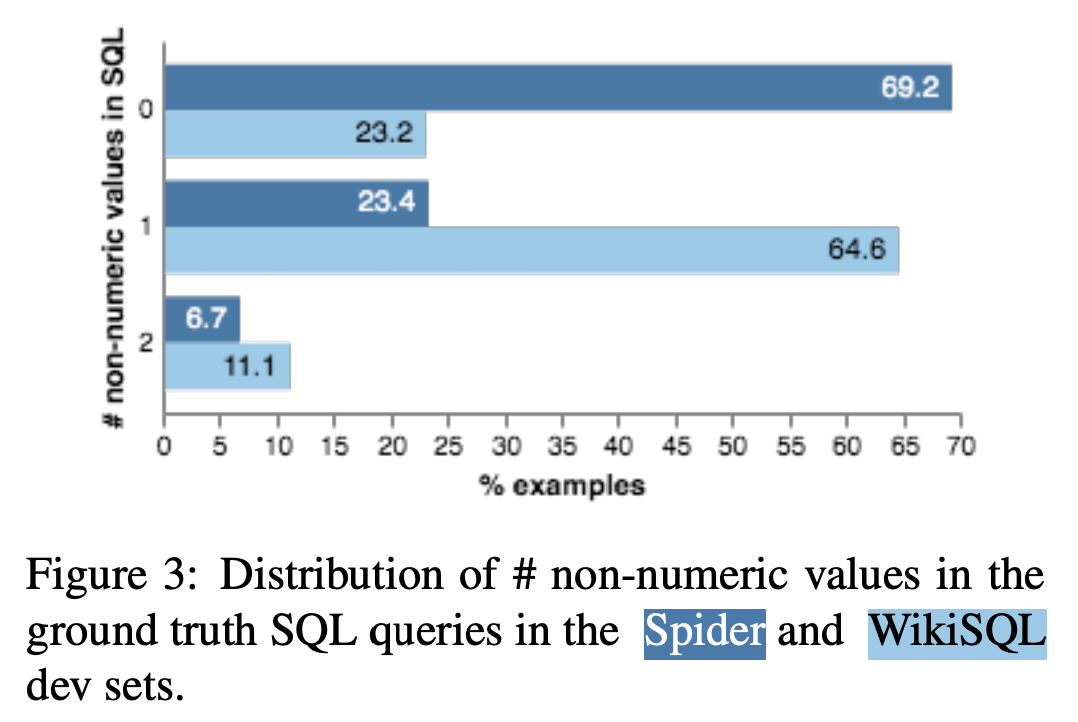
- 알고리즘을 사용해 각 필드에서 k개의 매칭을 고름
- Figure 3에서 보듯이, SQL에서 숫자가 없는 비율은 Spider=69.2%, WikiSQL=23.2% 이기 때문에 단어와 매칭되는 bridging 방법은 매우 유용하다고 주장
Training
- 논문 참고
5. Results
5.1 End-to-end Performance Evaluation
5.1.1 Spider
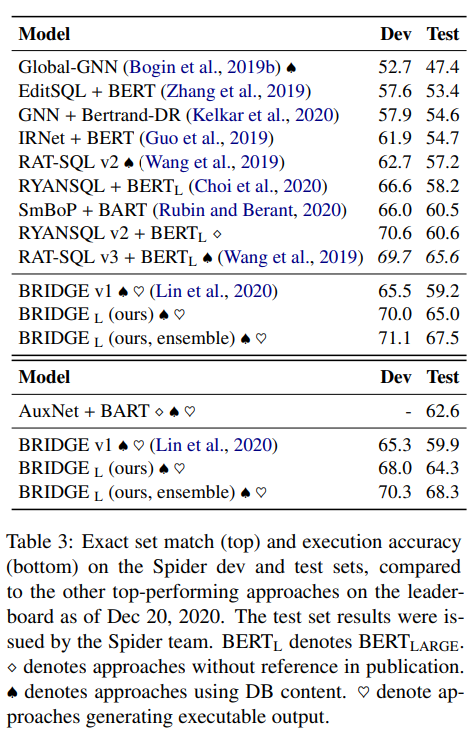
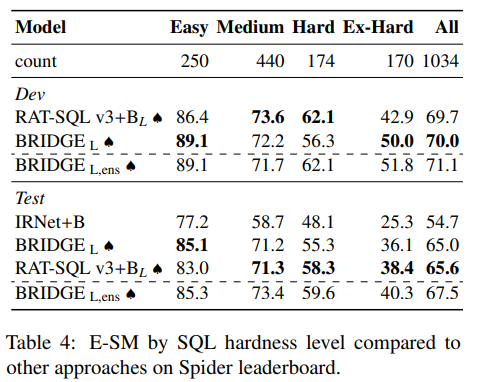
5.1.2 WikiSQL
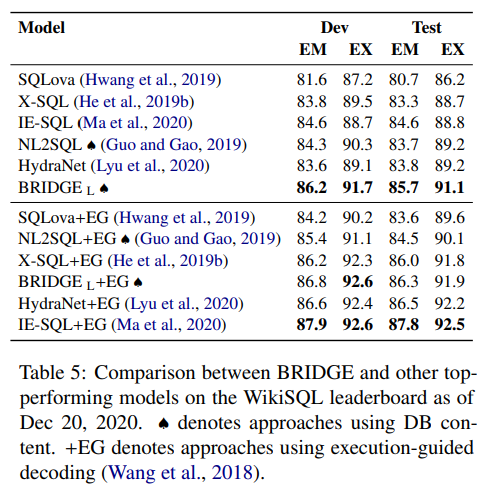
5.2 Ablation Study
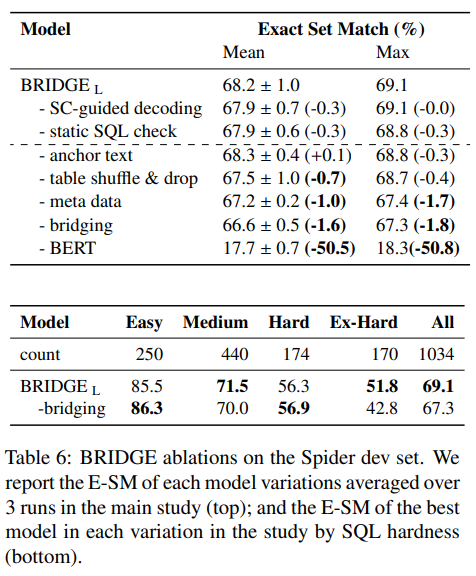
- decoding search space를 줄이는 전략이 어느정도 효과적
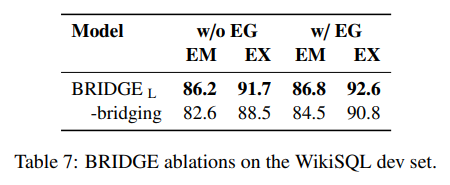
- bridging 하는 것과 그렇지 않은 것은 ex-hard에서 성능향상을 불러왔다.
- 메타 데이터를 인코딩하는게 도움이 됨
- BERT 레이어에서 질의와 anchor text에 등장한 단어와 연관이 있는 것을 확인 할 수 있었다.
5.3 Error Analysis
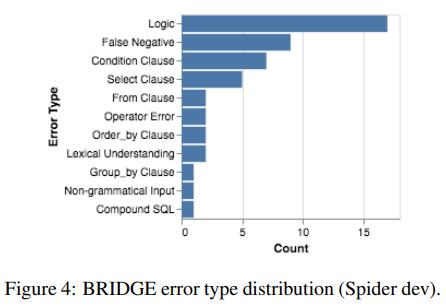
5.3.1 Manual Evaluation
5.3.2 Qualitative Analysis
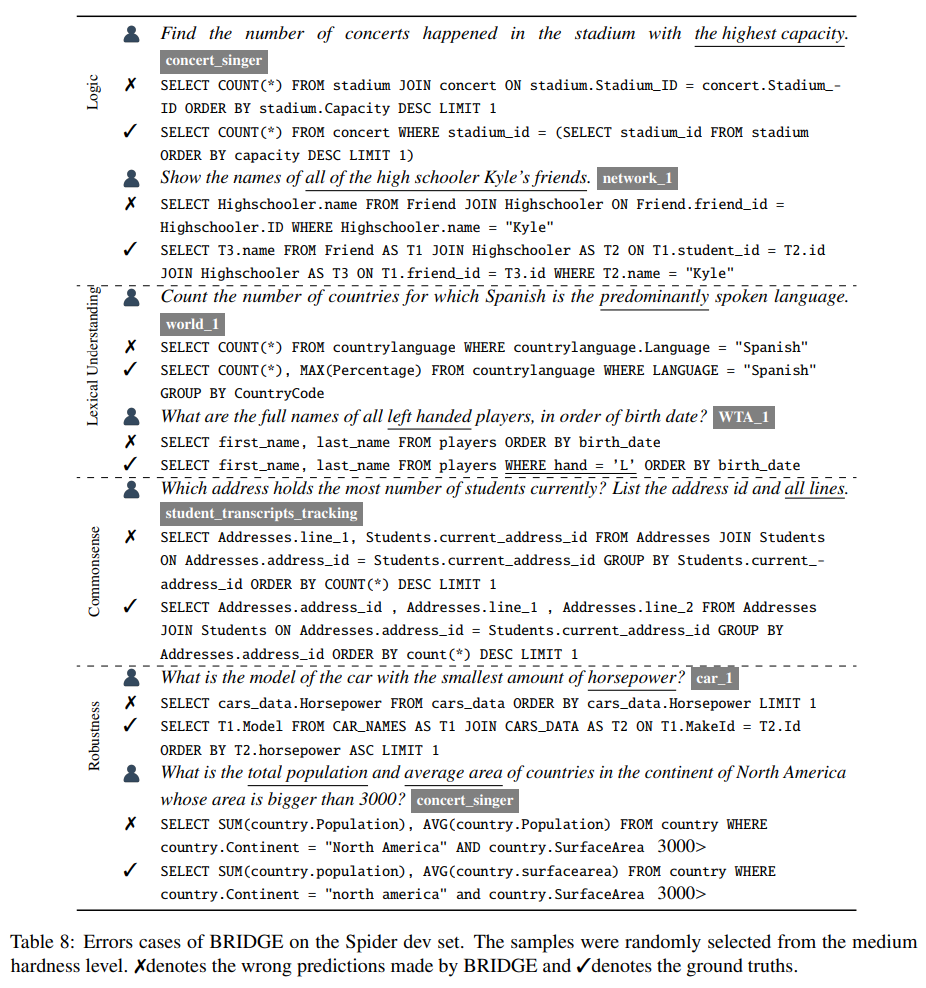
- Logic Error: 보통 모델이 훈련 세트에서 학습했던 것을 dev에서 틀리는 경우가 많음
- Lexcial Understanding: 보지 못했던 단어가 등장하는 경우 자주 나옴
- Common Sense: continuous learning이 솔루션이 될 수 있음
- Robustness: 주로 논리가 복잡하지 않은 경우에도 발화의 정보를 노골적으로 무시하는 모델과 관련
Demo
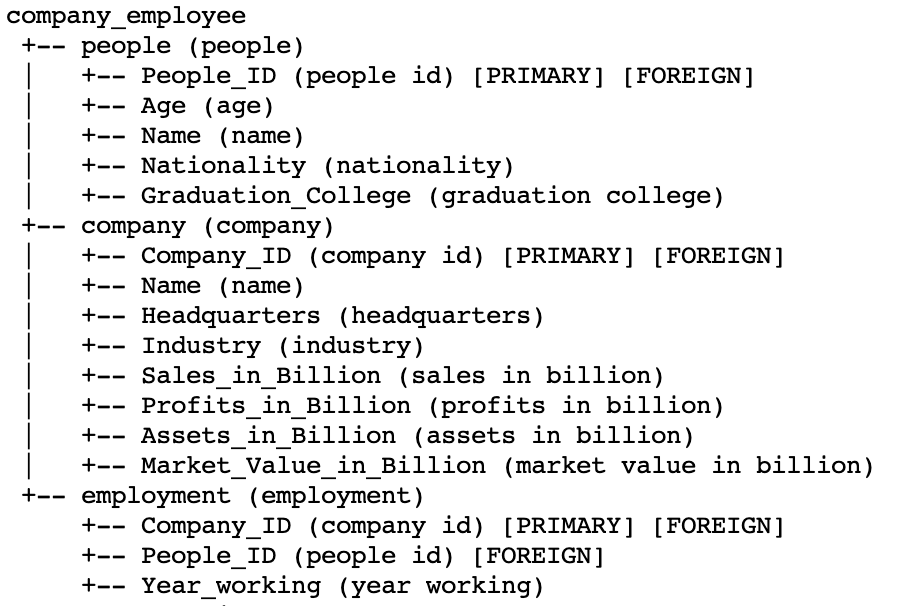
코드를 실행하여 결과가 어떤지 살펴보았다. 아래는 테이블 정보다.
Good Case
Query: how many people is in this company?
SELECT COUNT(*) FROM employment
JOIN company ON employment.Company_ID = company.Company_ID 
Query: show me all unique company headquaters
SELECT DISTINCT company.Headquarters FROM company
Bad Case
Query: what is the most market value headquarter name and who is working in there?
SELECT company.Market_Value_in_Billion, people.Name FROM employment
JOIN people ON employment.People_ID = people.People_ID
JOIN company ON employment.Company_ID = company.Company_ID
WHERE people.Name = "aquater aname"
ORDER BY company.Market_Value_in_Billion DESC LIMIT 1 
Query: what is the average age of empolyees?
SELECT AVG(people.Age) FROM people
WHERE people.Name = "empolye VALUE" 