Notes

CS 285: Lecture 20, Inverse Reinforcement Learning

영상링크: https://youtu.be/EcxpbhDeuZw Why should we w...

영상링크: https://youtu.be/EcxpbhDeuZw

Why should we worry about learning rewards?

  • Imitation Learning 관점: 로봇과 다르게 사람은 모방하는 과정에서는 행동(action)을 모방하지 않고, 의도(intent)를 모방하려고 함. 이는 다양한 다른 행동을 만들어 낼 수 있음.

Inverse Reinforcement Learning

  • IRL은 demonstrations으로부터 reward function을 학습하는 것을 목표로 함. HeadImg

Feature matching IRL

  • Linear reward function: rψ(s,a)=iψifi(s,a)=ψTf(s,a)r_\psi(s, a) = \sum_i \psi_i f_i(s,a) = \psi^T f(s, a)
  • 중요한 feature의 expectation을 매칭하는 과정
  • πrψ\pi^{r_\psi} 를 optimal policy 라고하면 원하는 것은 Eπrψ[f(s,a)]=Eπ[f(s,a)]\Bbb{E}_{\pi^{r_\psi}}[f(s, a)] = \Bbb{E}_{\pi^{*}}[f(s, a)] 를 만족하는 ψ\psi 를 찾는 것.
“maximum margin priciple”
maxψ,m ms.t.ψTEπ[f(s,a)]maxπinΠ ψTEπ[f(s,a)+m] \underset{\psi, m}{\max}\ m \quad \text{s.t.} \quad \psi^T \Bbb{E}_{\pi^{*}}[f(s, a)] \geq \underset{\pi in \Pi}{\max}\ \psi^T \Bbb{E}_\pi \lbrack f(s, a) + m \rbrack
* 휴리스틱함
* 그래서 SVM으로 해결해보려고 함

HeadImg

Learning the Reward Function

HeadImg

  • The optimality variable를 학습하여 reward function을 추정하자
  • p(Otst,at,ψ)=exp(rψ(st,at))p(\mathcal{O}_t \vert s_t, a_t, \psi) = \exp \big( r_\psi (s_t, a_t) \big)
  • demonstations from π(τ)\pi^*(\tau): {τi}\lbrace \tau_i \rbrace
  • p(τO1:T,ψ)p(τ)exp(trψ(st,at))p(\tau \vert \mathcal{O}_{1:T}, \psi) \propto p(\tau) \exp \big( \sum_t r_\psi (s_t, a_t) \big), 여기서 p(τ)p(\tau)ψ\psi과 독립이기 때문에 생략 가능
  • Maximum likelihood learning: maxψ 1Ni=1Nlogp(τiO1:T,ψ)=maxψ 1Ni=1Nrψ(τi)logZ\underset{\psi}{\max}\ \dfrac{1}{N}\sum_{i=1}^N \log p(\tau_i \vert \mathcal{O}_{1:T}, \psi) = \underset{\psi}{\max}\ \dfrac{1}{N}\sum_{i=1}^N r_\psi (\tau_i) - \log Z
  • ZZ가 학습을 힘들게함

The IRL Particion function

  • Z=p(τ)exp(trψ(st,at))Z = \int p(\tau) \exp \big( \sum_t r_\psi (s_t, a_t) \big), maxψ 1Ni=1Nrψ(τi)logZ\underset{\psi}{\max}\ \dfrac{1}{N}\sum_{i=1}^N r_\psi (\tau_i) - \log Z
  • gradient: ψL=1Ni=1Nψrψ(τi)1Zp(τ)exp(trψ(st,at))ψrψ(τ)dτ\triangledown_\psi L = \dfrac{1}{N} \sum_{i=1}^N \triangledown_\psi r_\psi (\tau_i) - \dfrac{1}{Z} \int p(\tau) \exp \big( \sum_t r_\psi (s_t, a_t) \big) \triangledown_\psi r_\psi (\tau) d\tau
    • 1Zp(τ)exp(trψ(st,at))=p(τO1:T,ψ)\dfrac{1}{Z} \int p(\tau) \exp \big( \sum_t r_\psi (s_t, a_t) \big) = p(\tau \vert \mathcal{O}_{1:T}, \psi) 이기 때문에
  • ψL=Eτπ(τ)[ψrψ(τi)]Eτπ(τO1:T,ψ)[ψrψ(τ)]\triangledown_\psi L = \Bbb{E}_{\tau \sim \pi^*(\tau)} \lbrack \triangledown_\psi r_\psi(\tau_i) \rbrack - \Bbb{E}_{\tau \sim \pi^*(\tau \vert \mathcal{O}_{1:T}, \psi)} \lbrack \triangledown_\psi r_\psi(\tau) \rbrack
    • 앞의 항은 expert samples의 추정치이고, 뒤의 항은 현재 reward 하에서 soft optimal policy 다.
  • 이를 풀어쓰면 backward message(β\beta)와 forward message(α\alpha)와 연관시킬 수 있음

Estimating the expectation

“1”
“2”

The MaxEnt IRL algorithm1

HeadImg

  • 필요:

    • Solving for (soft) optimal policy in the inner loop
    • Enumerating all state-action tuples for visitation frequency and gradient
  • 단점 및 한계점:

    • Large and continuous state and action spaces
    • States obtained via sampling only
    • Unknown dynamics

Approximations in High Dimensions

Guided cost learning algorithm2

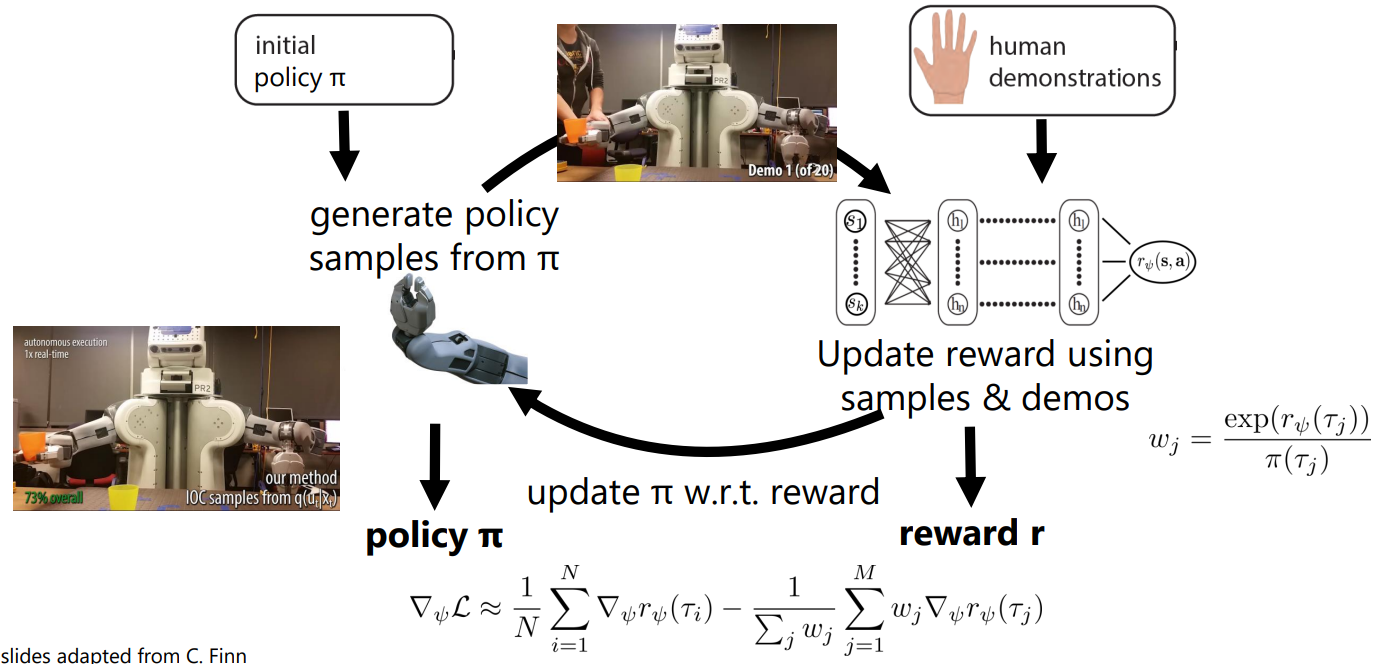
  • Unknown dynamics & large state/action spaces 일 경우 일반 강화학습처엄 sample 할 수 있음 HeadImg

  • sample-based 방법으로 효율적인 업데이트가능

“More efficient sample-based updates”
“Importance sampling”
  • policy samples를 먼저 생성 \rightarrow 사람 demonstrations과 같이 reward function을 추정 \rightarrow policy를 업데이트 HeadImg

Footnotes

  1. Maximum Entropy Inverse Reinforcement Learning - Brian D. Ziebart, Andrew Maas, J.Andrew Bagnell, and Anind K. Dey

  2. Guided Cost Learning: Deep Inverse Optimal Control via Policy Optimization - Chelsea Finn, Sergey Levine, Pieter Abbeel